
Most of our shop time lately has gone into a CNC machine rather than a circuit board. It runs, it cuts, and the first real job it did was cutting its own parts. Then we asked it to do the one thing every new machine should do before it does anything else, and it told us the table underneath it was bent.
Why there is a CNC in a vehicle project at all
We wrote about this back in August, and it is still the short answer: the trailer that started TrailCurrent needs cabinets.
Cabinets in a vehicle are a genuinely hard woodworking job. Nothing is square, no two panels are the same shape, and material is expensive enough that a mistake costs real money. Cutting all of that by hand is a long weekend of measuring twice and swearing anyway. A machine turns it into a file you check on screen and a job you press start on.
There is a second reason, and it is the more interesting one. Some of those cabinets are going to be built around TrailCurrent itself. A cabinet with the wiring runs already in it. Enclosures that live inside the furniture instead of being screwed to a wall next to it. That is not something you retrofit neatly. It has to be designed in from the start, which means the furniture and the electronics get drawn in the same place.
Thank you, Ryan
The machine is a LowRider V4, designed by Ryan at V1 Engineering and given away for free.
We want to be clear about what that means, because it is the exact thing we try to do here. Ryan did the hard part. He worked out the geometry, the printed parts, the hardware list, and the assembly, then published all of it so that anybody with a printer and a weekend can have a large format CNC in their garage without asking permission or paying a licence. There is a full set of documentation and an active forum full of people who have already made every mistake you are about to make.
If you have ever thought about building one, start at docs.v1e.com/lowrider. That is the whole project, openly. We are not affiliated with V1 Engineering in any way. We just built one, it works, and the person who made that possible deserves the credit by name.
This is the part of open source that does not get talked about enough. We publish our modules so somebody else can skip the hard year we spent figuring them out. Somebody did exactly that for us, and now there is a machine in our shop that is going to build the inside of a trailer. It goes both directions, and it only works if people keep sending it back out.
What went right, and then what did not
The build went well. The first job we gave it was cutting the strut plates, which are structural parts of the machine itself, and it cut them cleanly with no drama. That is a good feeling. A machine that can make its own parts is a machine you can keep improving.
The next step is surfacing the spoilboard. The spoilboard is the sacrificial sheet the machine cuts on top of, and surfacing means running the cutter across the whole thing to shave it perfectly flat, using the machine's own idea of flat as the reference. Every CNC gets this done early, because from that moment on the machine knows exactly where the surface is.
Except we did not get that far. Setting up for it made it obvious that the table holding everything up was warped. It was built from box store lumber, which is dried fast, stacked badly, and sold by the piece to people building shelves. It moves, and ours had.
Surfacing would not have saved it. You can shave a wavy sheet flat once, and then the wood underneath keeps moving and takes your flat surface with it. The reference has to be something that stays put.
So the table gets built first
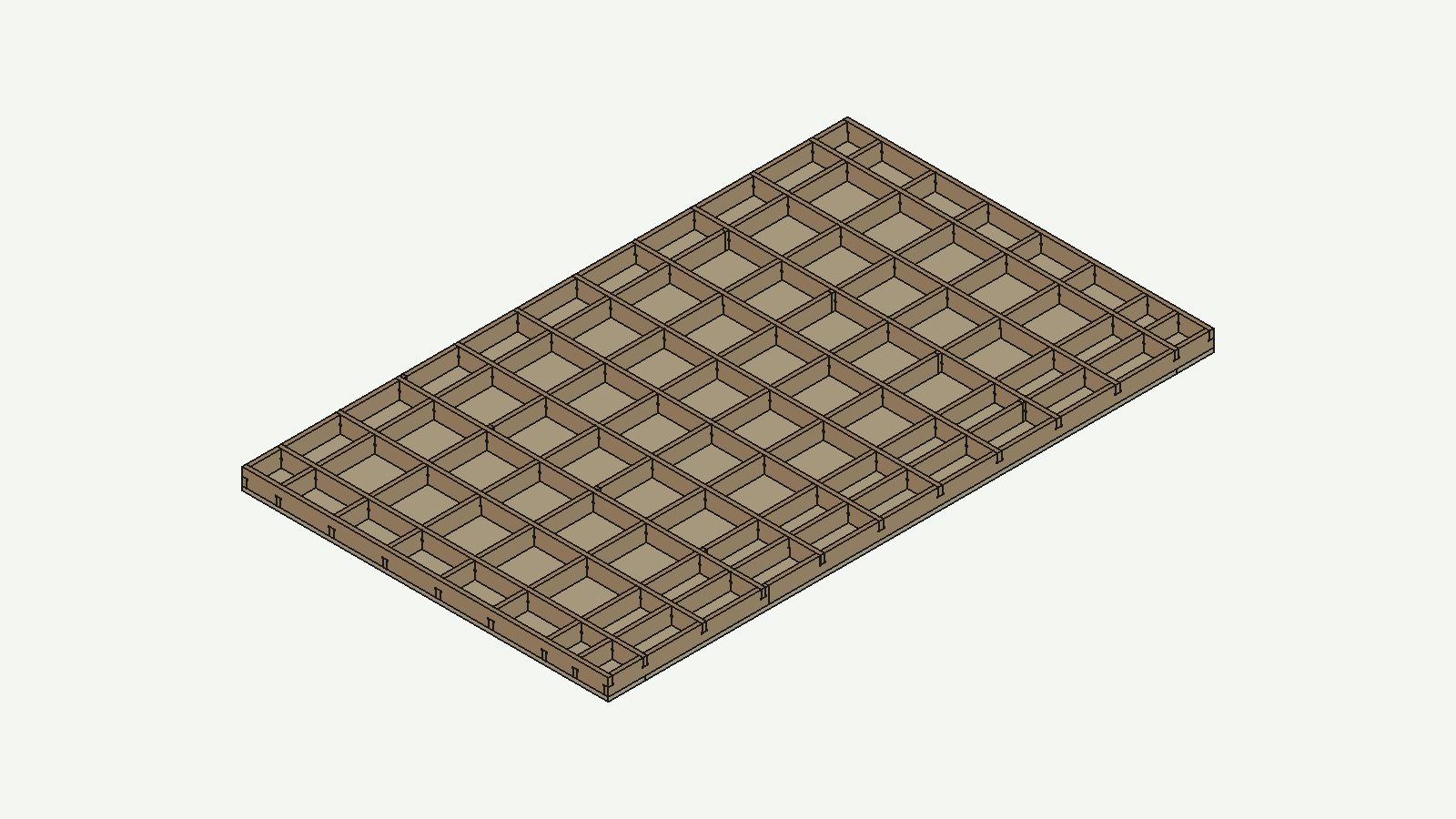
The fix is a torsion table, and the idea behind it is older and simpler than it looks.
Take a grid of thin strips standing on edge, slotted into each other like an egg carton, then glue a flat sheet onto the top and another onto the bottom. On its own, every part of that is floppy. Glued together as a closed box, it becomes extremely stiff and very light, and it stays that way. It is the same trick as a hollow core door or an aircraft wing. Aluminium extrusion or steel would also work and would cost a great deal more.
The one that matters for us: the top surface is a single uncut sheet. It never gets a seam, so there is no joint anywhere in the middle to telegraph through. That sheet, held flat by everything underneath it, becomes the reference the whole machine works against.
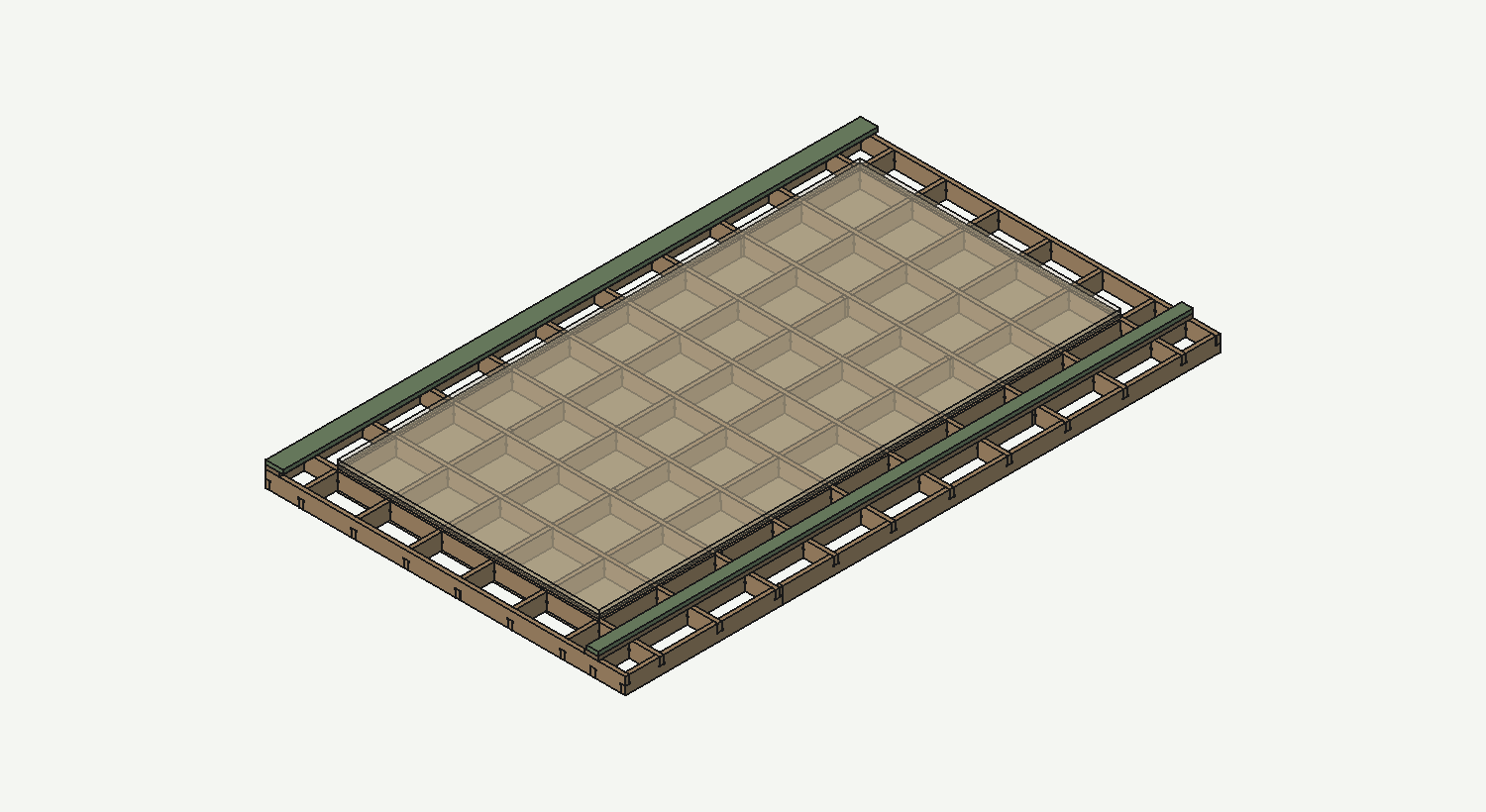
We drew the whole thing in FreeCAD, which is free and open source, and generated the machine instructions from that same model. Change a dimension, and the cutting files follow. That is the same discipline we use on every enclosure and circuit board we publish, applied to a piece of shop furniture, and it is worth the effort for exactly one reason: there are a lot of identical slots in that grid, and every one of them has to fit.
More connected than it looks
From the outside this probably reads like a detour. A vehicle electronics project spends a month on shop furniture. Look at what is actually running, though, and it is the same handful of parts we work on every day.
The board controlling the machine is an ESP32, the same family of chip that runs every TrailCurrent module in the trailer. The firmware on it is FluidNC, which is free and open source, and which we now trust with a spinning cutter and a full sheet of material. The handheld pendant we drive it with is built on the same Waveshare seven inch ESP32-P4 touch panel that runs Fireside, the portable panel you carry out to the campfire to check your batteries.
Same chips, same screens, same tools we use to draw every interface in the rig. Here is the pendant itself:
The screens on it were laid out exactly the way we lay out the ones on your wall, and that part turned into a video of its own.
So the machine is not a side quest that happens to share a building with the rest of the work. It runs on the stack we already know, it was set up with the tools we already use, and it is about to start cutting the furniture that stack is going to live inside.
Where it stands right now
Honestly, mid-build. The first sheet is cut, so the ribs that run across the table are done and stacked. The instructions for the second sheet are generated and the material for the rest of it is bought and sitting in the shop, but nothing else has been cut yet. Then the sheets go on, everything gets glued and screwed, and the machine moves onto a surface that will not argue with it.
A few of the machine's own parts get remade at the same time. Cutting the table taught us the current build is about half an inch short of handling a full sheet of material, which is the kind of thing you only find out by trying. So a handful of pieces get cut slightly longer while we are set up to cut things anyway.
Then the fun part. Cabinet doors, drawer fronts, and the first pieces of furniture designed from the beginning to have a TrailCurrent system living inside them.
Everything in this chain is open source, top to bottom. The machine design is Ryan's. The controller firmware is FluidNC. The model and the toolpaths are FreeCAD. The pendant we built to drive it is on our GitHub like everything else we make. Not one piece of that required a licence, a subscription, or a phone call to a salesperson, and that is not a coincidence. It is the whole point.
We will post the finished table when it is standing. New posts land here first, and the videos go up on the open source channel as we make them.